Maintain Language Codes

With the Maintain Language Codes function you select the languages you want available for selection in the Language Code fields throughout CGM webPRACTICE. The language codes are pre-loaded in a standardized system table (the ISO 639-2 language codes maintained by the Library of Congress); you import the ones your practice uses and activate or inactivate them as needed. Only the codes marked Active are available for selection when you record a patient's language.

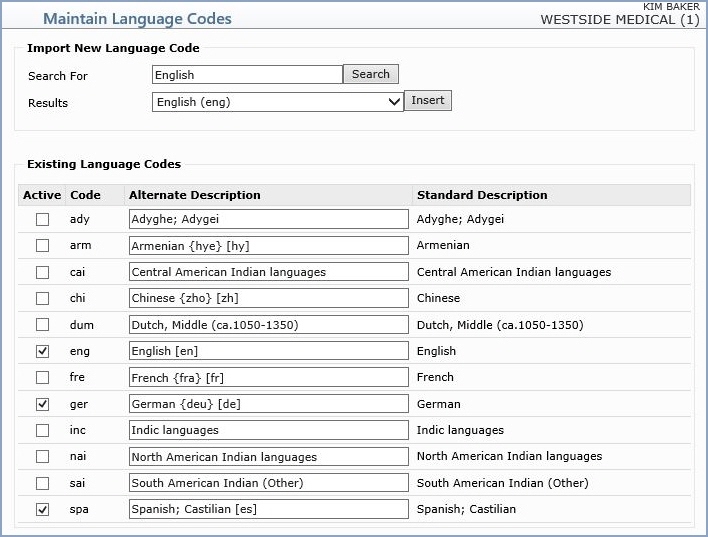
Upon accessing this function, the Maintain Language Codes screen displays with a list of the language codes already in the table.


Import New Language Code
Prompt Response Req Len
Search For Type the name of the language, or the first few characters of the name, and click Search to search the pre-loaded system table.    
Results Languages matching your search populate this drop-down list. Select the language you want and click Insert to add it to the Existing Language Codes list as an active code.    

Existing Language Codes
Each language code you insert displays in this section. The columns are:

Active - Select the check box to activate the code, or clear it to inactivate the code. Only active codes appear for selection in the Language Code drop-down lists throughout CGM webPRACTICE.

Code - The three-character ISO 639-2 language code.

Alternate Description - The description that displays and prints for the code. You can edit this description if needed. For the languages that have them, the Alternate Description also shows the ISO 639-2 Terminology (T) code in braces { } and the ISO 639-1 code in brackets [ ] - for example, English [en] or German {deu} [de]. When an ISO 639-1 code exists, it must be stored in the EHR for the patient's language to help meet Meaningful Use Stage 2 requirements for EHRs.

Standard Description - The standard language name supplied by the system.

After you have inserted and activated all the language codes that will be used by your practice, click Save.

If you are the System Manager for CGM webPRACTICE, you should limit access to the Maintain function to select staff members. You should also provide guidelines (customized to your practice) to these staff members for entering table data in a consistent manner. This should protect the integrity of your table information.

To add or modify data for the codes in the table, a user must have the Allow Table Update check box selected in Maintain Users under System, User Management, and be given the appropriate security level. For additional information about security levels, see the Function Security Menu under System, User Management. For setting up user codes, see Maintain Users. If the Maintain function is accessed and the user is not authorized to 'Allow Table Update', the Insert function will be unavailable and the user will only be allowed to Review the codes. If the user does not have the appropriate security level to access the Maintain function, codes can also be reviewed using the Review a Language Code function.