Import and Post ERA Files
With the Import and Post ERA Files function you can import, post,
print, archive, and delete electronic remittance files from a single screen.
Upon accessing this function, the system automatically checks to see if
any new files are available to be imported from the Import Path
stored in the ERA Integration Setup
function and from eMEDIX. A status message displays while available remit
files are imported, and any duplicate ERA files are automatically archived
during the import process. When the screen displays, it lists all of the
ERA files for the database.
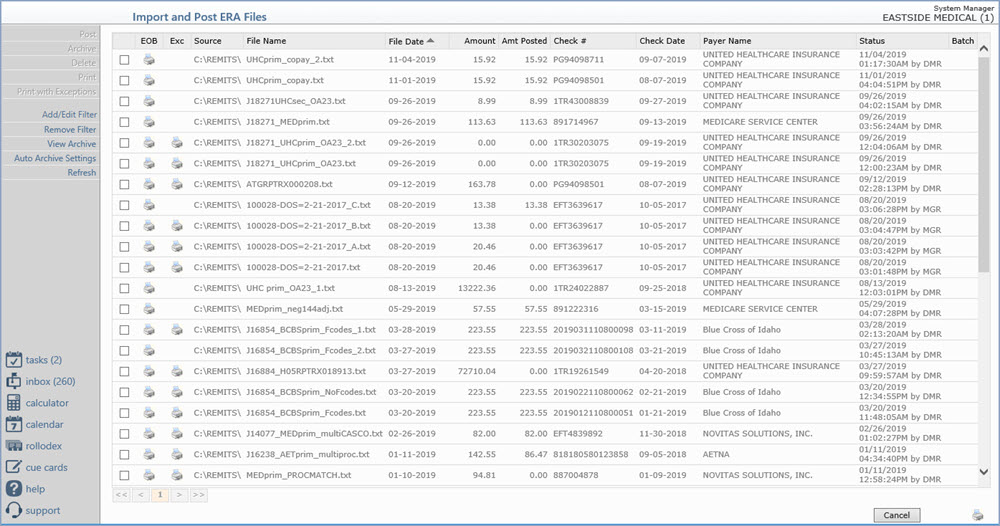
ERAs in black font have not yet been posted. ERAs in gray
font have been posted; the font turns from black to gray after an ERA
is posted.
Columns
- The check box in the column header is a Select All check
box. Selecting it selects every file in the list, which lets you perform
an action on multiple files at one time (for example, archive all
selected files at once). Clearing the check box clears any selected
files.
- EOB — Click the printer icon to print the EOB for the ERA
in that row. You can print and reprint EOBs as many times as needed,
including after the remit has been posted.
- Exc — Displays a printer icon when an Electronic Remittance
Exception Report is available for the ERA. Click the icon to print
or reprint the exception report.
- Source — The original source of the remit file. ERAs imported
from eMEDIX display eMEDIX; ERAs imported through a direct
path display the Import Path from the ERA Integration Setup.
- File Name — The remit file name. If a payer reuses a file
name, the new file is renamed automatically so file names remain unique.
- File Date — The date the remit file was received.
- Amount — The total check amount on the remit file.
- Amt Posted — The total amount of payments automatically
posted when the file was imported and posted, so you can quickly determine
whether the entire check posted or if some payments were placed on
the Payment Exception report and need attention.
- Check # — The check or EFT number from the remit.
- Check Date — The check date from the remit.
- Payer Name — The name of the insurance carrier that sent
the remit.
- Status — Displays one of the following: the date, time,
and User code of the user who posted the ERA; In Progress when
the remit is in the process of being posted; or a message indicating
the file could not finish posting, in which case the row turns gray
and inactive and you must contact CGM Customer Service for assistance.
- Batch — The Batch number entered for the posted ERA.
Action Column Buttons
Select the check box for one or more rows and the Action Column buttons
become available so you can print, post, or perform other actions on the
selected files.

- Post — Posts the selected ERA(s). Available only when a
selected ERA has not yet been posted.
- Archive — Archives the selected files so they no longer
display in the active view, letting you focus on files that still
need to be processed.
- Delete — Removes the selected ERAs.
- Print — Prints the EOB for each selected ERA.
- Print with Exceptions — Prints each selected ERA followed
by its corresponding exception report when one is available. The Electronic
Remittance Exception Report can also be printed to Microsoft Excel
by selecting the Microsoft Excel via MyReports option from
the Printers dialog box.
- Add/Edit Filter — Opens the filter screen so you can apply
a filter based on any combination of the file criteria to quickly
locate and isolate specific files.
- Remove Filter — Clears the active filter and returns the
screen to the full list of files.
- View Archive — Toggles to the Archived ERA Files screen,
which displays files that have been archived. A filter is applied
automatically to display only archived files with file dates within
the last 60 days; edit the filter to display older archived files
as needed. The Print, Print with Exceptions, Add/Edit Filter, and
Remove Filter options are also available in this view. The button
toggles to View Active to return to the active list, or click
Cancel.
- Auto Archive Settings — Opens a screen where you can select
to automatically archive any posted ERA files older than a specified
number of days. When enabled, this process runs each evening.
- Refresh — Updates the Status column for any files currently
being processed. Use this if a file appears to be taking an unusually
long time to post to determine whether it is still processing or has
encountered an error.
There are occasions when an imported ERA file is corrupt. If this happens,
you must download the file again. A message indicating that the file is
corrupt displays.

Sample EOB
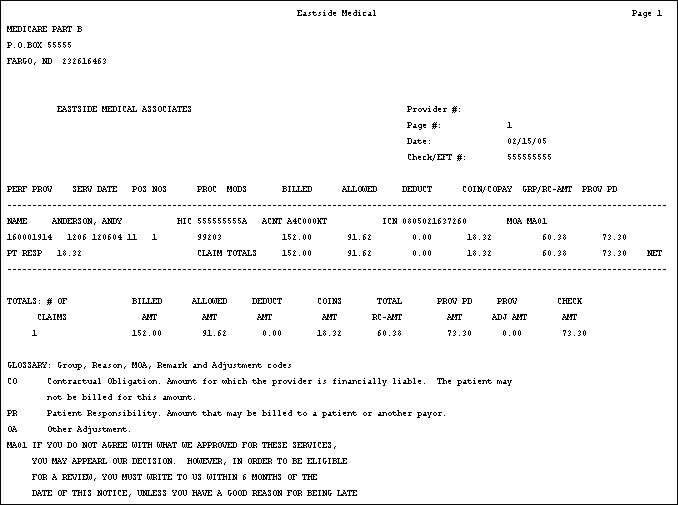
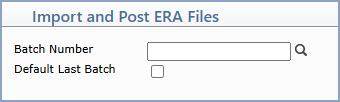
After printing the EOB, click the Post Action Column button. Enter
the Batch Number and select the Default Last Batch check
box if applicable. Click Save.
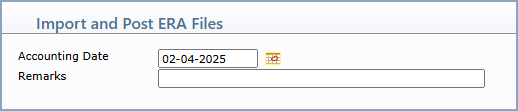
Next, select the Accounting Date and enter any Remarks. Click
Save.
After the payments have posted, print the Payment Exception report by clicking
the printer icon in the Exc column for the row containing the ERA
information, so you can resolve any issues and manually post the excepted
payments. After all the excepted payments are manually posted, print the
payment journal and compare it to the EOB you printed when the file was
first imported. The totals for each report should match, which indicates
the file is in balance. If the totals do not balance, review each report
in detail and confirm that each item on the EOB is also listed on the
Payment Journal and that all dollar amounts match.
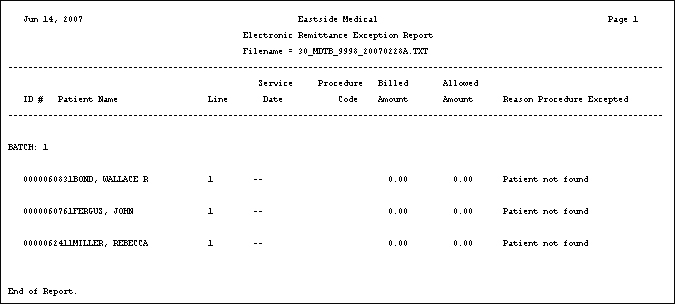
Sample Report
The Electronic Remittance Exception Report heading lists the Payer Name,
File Date, Check Date, Check #, Check Amount, and Batch. The body of the
report lists, for each provider and patient, the patient account number,
Pat Ctrl #, ERA Line, Beginning Service Date, Ending Service Date, Procedure
Code, Billed Amount, and Allowed Amount, with the Exception Code, Exception
Reason, and Adjustment Code printed directly under each procedure line
item. Warning messages are preceded by an asterisk (*), with the full
warning text printed at the end of the report.
See the full list of the ERA
Payment Exception Messages for assistance with resolving the issues.