History
With the History function, you can review the patient's transaction
history without having to exit this function to access Review Patient
Information.
- You can customize the text color and font style for the various
types of transactions using the Configure
Colors function.
- If there are any DMS Notes stored on an account, two asterisks
(**) display following the patient's name. Click Notes in the
Action Column to review the DMS Notes.
- To view the transactions for 'All Cases', or only those related
to a particular case, select the case option from the case list box
in the upper-right corner above the format list box. The case number
for each transaction is listed in the Case column in the transaction
history screen.
- If you hover over a transaction row and if there are any Notes
stored with the same accounting date, those notes will display. If
you hover over a transaction row and if there are any INOTES stored
with the same date of service, those notes will display.
- If you hover over the procedure code or procedure description,
the procedure code, brief description, and equivalent code (if one
exists) displays.
- The 'I' column contains a code (flag) for the insurance
filing status and a code for the accept assignment indicator. If you
hover over these codes, their description displays.
- Insurance Status Codes:
- B = Balance Transfer - This charge has been transferred
from the Insurance Balance to the Patient Balance with the
Transfer
Insurance Balances function.
- C = Collection Status - If you use Patient
Collections, this indicates the transaction is in the
collection process.
- D = Denied - This procedure has been denied by one of the
patient's insurance carriers. The insurance ledger indicates
the carrier and the denial reason.
- E = Electronically Filed - This procedure has been filed
to the patient's insurance carrier electronically.
- F = Filed - This procedure has been filed to the patient's
primary insurance carrier.
- H = Held - This procedure has been held from being billed
to the insurance company with a Claim Hold date entered
in the Procedure
Entry Function.
- P = Pended - The insurance carrier has responded in some
form, but has not yet paid nor denied the claim.
- * = Refiled - This procedure has been refiled to one of
the patient's insurance carriers. The insurance ledger indicates
which carrier.
- S = Secondary Filed - This procedure has been filed to
the patient's secondary insurance carrier.
- T = Tertiary Filed - This procedure has been filed to the
patient's tertiary insurance carrier.
- V = Void - This transaction has been voided.
- Assignment Status:
- Y = Yes - Assignment was accepted on this procedure.
- N = No - Assignment was not accepted on this procedure.
- You can view the saved image for any transaction by clicking the
image icon in the Img column and the image displays in a new
window. When you finish viewing the image, click the 'X' in the upper-right
corner of the Image Management window and the transaction history
screen re-displays. The various types of images that can viewed in
Transaction History are:
- Patient Collection Letters - you must use DMS letters and have
the Adj Code for Letters field completed in the Patient
Collections Integration function.
- Electronic Patient Collection Letters - If you use CGM
ECOLLECTIONS to send your patient collection letters electronically.
- Insurance Collection Letters - you must use DMS letters and
have the Adj Code for Letters field completed in the Insurance
Collections Integration function.
- Electronic Patient Statements - you must send electronic patient
statements and have the Adj Code for Stmts field completed
in the CGM
webPRACTICE Default Values function.
- Electronic Superbills - if you hover over the superbill image
icon (sb), the superbill number and any superbill notes display.
- Explanations of Benefits - if a payment already has an EOB
image scanned and attached to it, the scanned image will override
the auto-generated version.
- NOTE: The 'Act' (Actions) column at the far right of the
screen can only be accessed in the History
function in Change Patient Data.
- The Account Balance, Total Charges, Insurance Balance, and Patient
Balance are listed across the bottom of the screen.
You can view the detail of any transaction by selecting it. To select
a transaction, click anywhere in the row containing the transaction information.
The transaction detail displays in a new window. When you have finished
reviewing the detail, click Close and the Transaction History screen
re-displays.
- Transaction History Detail for Charges: The top section
of this screen includes: the accounting date; date of service; procedure
code and description; the diagnosis code(s) (if you hover over the
diagnosis code, the description of the diagnosis displays); the procedure
amount and the (# of units @ that amount); the amount allowed by the
insurance company, if an insurance payment was posted; the performing
provider's code and name/the insurance doctor's code; the location
code and description; the department code and description; the service
script date (if one was entered); the referring doctor's code and
name; the date of illness/injury (if one was entered); the superbill
number; the insurance flag code; the alternate description if you
entered anything in the Remarks field when posting a payment
or an adjustment; the batch number; the accept assignment indicator;
the edited field reflects what you entered in the Editing Reason
field if you edited the transaction; the amount remaining (balance
due) on this transaction; and the claim delay date, if one was entered
on the original procedure entry or the claim delay reason code if
the claim was refiled with a claim delay reason. You can click on
the image icon next to View Superbill to view the electronic
superbill, (if your practice uses them and if one is attached to the
charge).
The middle section displays all of the payments and adjustments posted
to the charge with the accounting date; the payment or adjustment
code and description; the performing provider code; the location code;
the diagnosis code; the amount of the total payment or adjustment;
the amount of the payment or adjustment applied to this specific transaction;
the insurance flag code; and the image icon, if there is an image
attached to that payment. If you hover over the row(s) containing
the payment or adjustment information and if there are Notes stored
on the account with the same accounting date, those notes will display.
You can view the detail of the payment or adjustment transaction by
clicking anywhere in the row containing the transaction information.
The bottom section of the screen displays the insurance ledger showing
payments, adjustments, filings, refilings and denials of the transaction/claim
with the date that the activity took place (not the accounting
date, payment date or date of service); the insurance carrier code
and name; the action taken on the transaction and the amount of the
action.
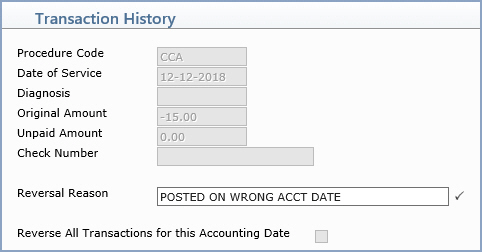
- Transaction History Detail for Payments: The top
section of this screen includes: the accounting date; payment date;
payment code and description; the payment amount; the insurance carrier
code; the alternate description if you entered anything in the Remarks
field when posting the payment or if the payment was reversed, the
Reversal Reason will display;
the batch number, the amount remaining (balance due) on this transaction;
the claim delay date, if one was entered on the original procedure
entry or the claim delay reason code if the claim was refiled with
a claim delay reason; and the check number. If there is an EOB attached
to this payment there is a View EOB field and you can click
on the image icon next to it to view the explanation of benefits.
The bottom section of this screen includes the accounting date, date
of service; the procedure code and description; the performing provider
code; the location code; the diagnosis code; the charge amount; the
amount of the payment applied to this specific transaction; the insurance
flag code and accept assignment indicator; and the image icon, if
there is an image attached to the transaction. If you hover over the
doctor code, the location code, or the insurance flag, the description
of these codes will display.
- Transaction History Detail for Adjustments: The top
section of this screen includes: the accounting date; adjustment date;
adjustment code and description; the adjustment amount; the alternate
description if you entered anything in the Remarks field when
posting the adjustment or if the adjustment was reversed, the Reversal Reason will display; the
batch number; the amount remaining (balance due) on this transaction;
and the claim delay date, if one was entered on the original procedure
entry or the claim delay reason code if the claim was refiled with
a claim delay reason.
The bottom section includes the accounting date, date of service; the
procedure code and description; the performing provider code; the
location code, the diagnosis code, the charge amount; and the amount
of the payments and adjustments applied to that charge; the insurance
flag and accept assignment indicator; and the image icon, if there
is an image attached to the transaction. If you hover over the doctor
code, the location code, or the insurance flag, the description of
these codes will display.
Date of Service Look-up Function - With this function, you can
review specific transactions for a selected date or date range. For example,
the account may contain multiple transactions for the month of May, but
you want to focus only on the charges posted for May 29th, and any payments
or adjustments allocated to those charges. To select a date, type the
date of service in the From and Thru fields or click the
calendar icon to select a date in the upper-right section of the transaction
history window. Click Refresh in the Action Column to display the
transactions for the selected date(s). The account totals listed across
the bottom of the screen are for the selected date(s) only. Click Print
in the Action Column to print the transaction history for the selected
date(s).
Transaction History Screen Formats - You can view the Transaction
History screen in a variety of formats. Select the format you want from
the format list box located in the upper-right corner under the case list
box.
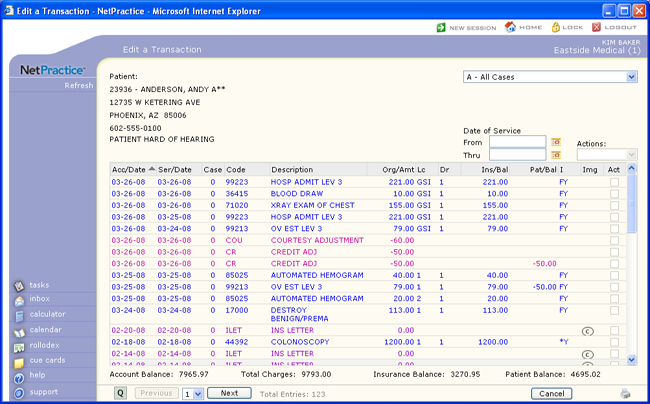
- All Transactions - All transactions are displayed, including
any reversed or voided transactions. The accounting date, service
date, case code, billing group code, transaction code and description,
original amount of the transaction, insurance balance, patient balance,
insurance flag, accept assignment indicator, and any image icon for
each transaction are displayed.
- Charges only - Only the charges on the account are displayed.
The accounting date, service date, case code, billing group code,
procedure code and description, original amount of the charge, insurance
balance, patient balance, insurance flag, accept assignment indicator,
and any image icon for each transaction are displayed.
- Encounter - Transaction history grouped by encounter by
accounting date is displayed.
Encounter View Action Column Buttons
- Notes — Opens the patient notes window.
- INotes — Opens the insurance notes window.
- Refresh — Refreshes the encounter list to reflect any
changes.
- Show/Hide Rev/Neg/Moved — This toggle button shows/hides
any reversed, negated, or moved transactions in the display. The
preferred view can be set in the Miscellaneous
section of the CGM
webPRACTICE Default Values function. The toggle button defaults
to the view as selected in the default values. The Show/Hide view
as currently selected on the screen will hold until you click
Cancel to cancel all the
way out of the function.
- Expand All/Collapse All — Toggle button. Expands or
Collapses every encounter currently displayed. You can select
wether you want this to always display as expanded upon entering
the function in the Miscellaneous
section of the CGM
webPRACTICE Default Values function.
- Select All/Clear All — Toggle button. Selects all encounters
or line items currently displayed; click again to Clear All. Use
caution with the Select All side of the toggle when followed by
an Edit Selected action.
- Add/Edit Filter — Opens the filter screen so you can
narrow the list to specific transactions.
- Remove Filter — Clears the active filter and returns
the screen to the full transaction list.
- Insurance w/Doctor - All transactions (except those that
have been reversed or voided) are displayed. The location code and
doctor code are displayed in addition to the accounting date, service
date, case code, transaction code and description, original amount
of the charge, insurance balance, patient balance, insurance flag,
accept assignment indicator, and any image icon for each transaction
are displayed.
- Insurance Collections - All charges that are currently in
an insurance collections status are displayed. You can select claims
for a specific insurance carrier or 'All Carriers' in the insurance
carrier list box to the right of the account demographic information.
If you select a specific carrier, the details of the patient's policy
with that carrier are displayed in the top-middle portion of the screen.
The accounting date, service date, case code, procedure code and description,
original amount of the charge, location code, doctor code, insurance
balance, patient balance, insurance flag, accept assignment indicator,
insurance collection status code and any image icon for each transaction
are displayed.
- Insurance Format - All charges, payments and adjustments
(except those that have been reversed or voided) are displayed in
the insurance format. The accounting date, service date, case code,
billing group code, transaction code and description, original amount
of the transaction, insurance balance, patient balance, insurance
flag, accept assignment indicator, and any image icon for each transaction
are displayed.
- Ledger Display - All charges, payments and adjustments (except
those that have been reversed or voided) are displayed in a ledger
format. This format displays the service date, transaction code and
description, original amount of the transaction, the total payment
and adjustment amounts applied to each transaction, the balance on
each transaction, insurance flag, and the accept assignment indicator.
The insurance ledger and transaction detail are also displayed below
each transaction.
- Ledger - Detailed - All charges, payments and adjustments
(except those that have been reversed or voided) are displayed in
a detailed ledger format. This format displays the same information
as the standard Ledger Display, but in addition, the performing (PDr)
and insurance (IDr) doctor codes are displayed for each charge immediately
following the charge description and the balance is broken down into
two columns for the insurance balance and patient balance.
- Payments only - Only the payments on the account are displayed.
The accounting date, service date, case code, billing group code,
transaction code and description, original amount of the payment,
any unapplied portion of the payment in the insurance or patient balance,
and any image icon for each payment are displayed.
Action Column Functions
- Notes - Click Notes to review the Note DMS
Records on the account.
- INotes - Click INotes to review the Insurance Notes
on the account.
- Print - Click Print to print the transaction history
on the account for a specified range of accounting dates.
- Refresh - Click Refresh to refresh/update the screen.
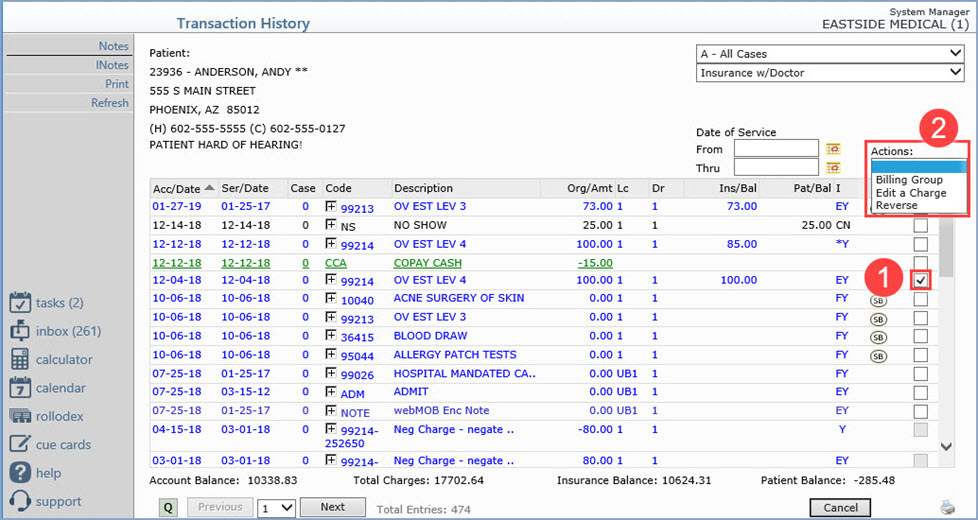
Actions
The 'Act' (Actions) column on the transaction
history screen is only available in Change Patient Data. It is
not accessible in Review Patient Information. To use this functionality,
select the check box(es) next to the transaction(s) you want to change
(1), then select an action from the Actions list (2). If you try
to access these functions without having the required security level,
a warning message displays and you will not be able to continue with the
action.
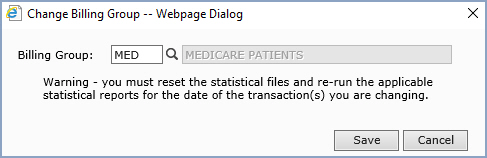
- Billing Group: If you want to change the Billing Group tied
to the transaction, select this action. If the Billing Period for
this date of service has been closed, a message displays to inform
you that you must re-open the closed billing period before changing
the Billing Group. Type the Billing Group code you want or click the
magnifying glass to search the table.
- Edit a Charge: You can only edit charge transactions
from this screen. When you select Edit a Charge, the standard
Edit an Encounter
screen displays.
- Reverse: You may only reverse payments or adjustments using
this function.